

Getting hurt at work is stressful enough. The last thing you need is to sit there wondering how much money you will actually receive while you recover. That is where a workers compensation calculator comes in.
A workers compensation calculator helps you get a rough idea of your weekly benefits before you even file a claim. It takes your wage, your injury type, and your state rules and gives you a number you can actually plan around.
In this guide, we will walk you through everything you need to know about using a workers compensation calculator, what goes into the math, and how to make sure your estimate is as close to the real number as possible.
What Is a Workers Compensation Calculator
A workers compensation calculator is a simple online tool that estimates how much money you might receive after a work injury. You put in a few details about your income and injury, and it does the math for you.
It is not a guaranteed number. Think of it like a weather forecast. It gives you a good idea of what to expect, but the final amount depends on your employer, your insurance company, and your state laws.
Most calculators are free to use and take less than a minute to complete.
How the Workers Compensation Calculator Works
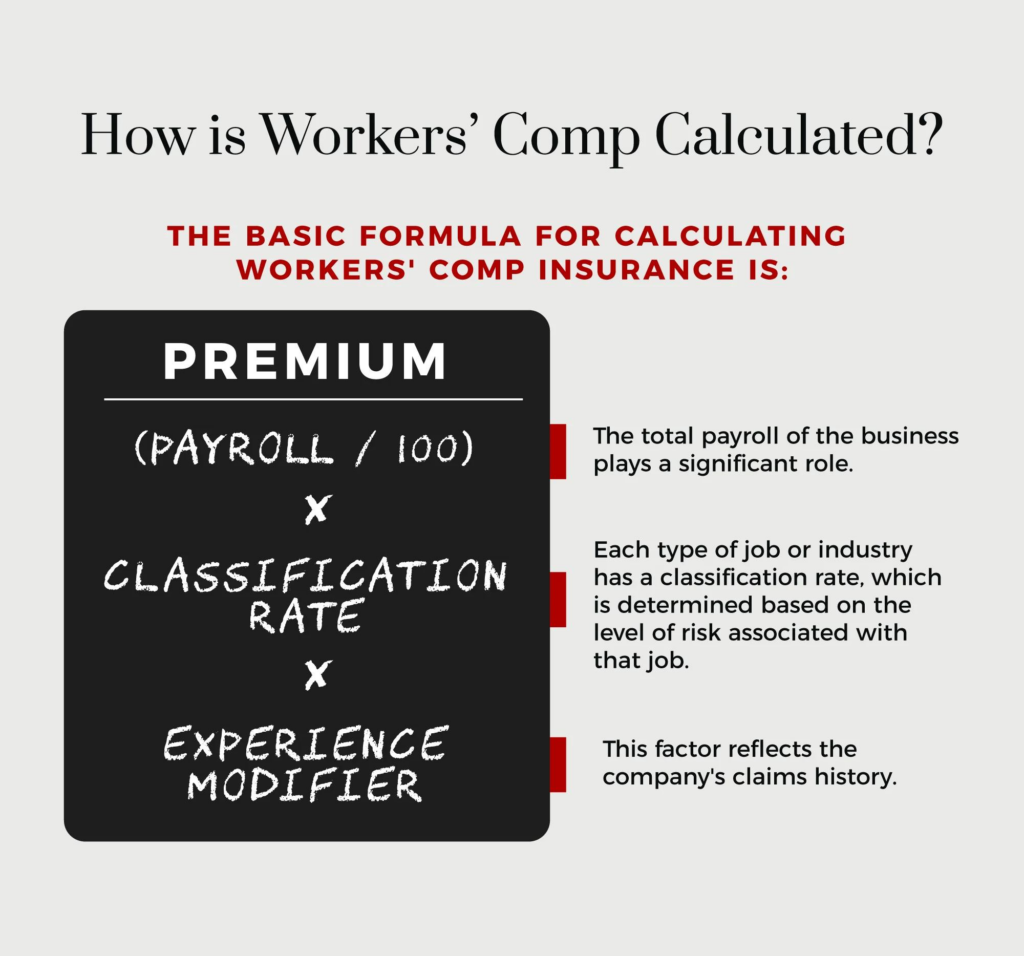
The calculator uses a formula that most states follow. Here is the basic idea:
Your average weekly wage is taken and multiplied by a percentage set by your state, usually somewhere between 60 and 70 percent. That number becomes your weekly benefit.
So if you earn $1,000 a week and your state pays 66 percent, your weekly benefit would be around $660.
But there are caps. Every state sets a maximum weekly amount. So even if your 66 percent comes out to $2,000, your state might cap it at $1,200. That is why using a workers compensation calculator specific to your state matters a lot.
Factors Used in Workers Compensation Calculation
Several things affect how your benefit is calculated. Here are the main ones:
Your average weekly wage. This is based on your earnings over the past 52 weeks or a set number of weeks before your injury.
Your disability type. Are you totally unable to work, or can you do light duty? This changes your benefit percentage.
Your state’s rules. Each state has its own minimum and maximum weekly benefit amounts.
Your number of dependents. Some states give you more if you have children or a spouse who depends on your income.
The nature of your injury. Permanent injuries are handled differently than temporary ones.
If you want a deeper look at what kinds of injuries qualify, check out our blog on [What Injuries Qualify for Workers Compensation (Powerful 2026)].
Average Weekly Wage (AWW) Explained
The Average Weekly Wage, or AWW, is the starting point for every workers compensation calculator. Getting this number right is the most important step.
To find your AWW, most states look at your total earnings over the 52 weeks before your injury and divide by 52. If you worked less than a full year, they adjust the math.
Things that count toward your AWW include your regular wages, overtime (in some states), bonuses, and sometimes tips or commissions.
Things that usually do not count include health insurance contributions, expense reimbursements, and pension payments.
If you are unsure how to work this out on your own, our guide on [How to Work Out Workers Compensation (Step-by-Step Guide 2026)] breaks it down in plain language.

How to Use Our Workers Compensation Calculator
Using the workers compensation calculator on our site is simple. Here is what you do:
- Enter your state
- Enter your average weekly wage
- Select your disability type (temporary total, permanent partial, etc.)
- Add the number of dependents if your state counts them
- Click calculate
Calculate Now workers compensation calculator
The tool will show you an estimated weekly benefit amount based on your state’s rules. It takes less than 60 seconds.
You can also use our Lost Wage Calculator if you want to estimate how much income you have already missed out on since your injury happened.
Example Calculation (Step-by-Step)
Let us walk through a real example so you can see how the math works.
Worker: Maria, a warehouse employee in Texas Weekly Wage: $900 Injury Type: Temporary Total Disability State Rate: 70 percent of AWW State Maximum: $1,066 per week
Step 1: Calculate 70 percent of $900 $900 x 0.70 = $630
Step 2: Check the state maximum $630 is below the $1,066 cap, so Maria receives $630 per week.
Step 3: Determine how long she receives it Texas pays temporary total disability benefits until she can return to work or reaches maximum medical improvement.
Simple, right? A workers compensation calculator does all of this automatically once you enter your numbers.
Estimate Your Weekly Benefits
Want to skip the math entirely? Use our workers compensation calculator right now. Just enter your wage, your state, and your injury type and get your estimate in seconds.
You can also try our Disability Benefits Calculator if your injury has led to a long-term or permanent condition. It gives you a bigger picture view of what you might receive over time.
State Differences in Workers Compensation Payments
This is one of the biggest things people miss. Workers compensation is not the same everywhere. Each state runs its own program with its own rules.
Here is a quick comparison of how a few states handle weekly benefits:
| State | Benefit Rate | Weekly Maximum |
|---|---|---|
| California | 60 to 70% of AWW | $1,619.00 |
| Texas | 70% of AWW | $1,066.00 |
| Florida | 66.67% of AWW | $1,313.00 |
| New York | 66.67% of AWW | $1,145.43 |
| Ohio | 72% of AWW | $1,325.00 |
For a full breakdown by location, read our [Workers Compensation Benefits by State (Updated Guide 2026)] guide. It covers every state and is updated for 2026.
Limitations of Workers Compensation Calculators
A workers compensation calculator is a great starting point, but it has limits. Here is what it cannot do:
It cannot account for disputes. If your employer contests your claim, the final number could be very different.
It cannot predict medical costs. Your medical treatment is separate from your wage benefits.
It cannot tell you how long your claim will take. Speaking of which, our [Claim Timeline Estimator] tool can help you figure out roughly how long your workers compensation claim process might run from start to finish.
It uses averages. Your actual AWW might be calculated differently by your state’s workers compensation board.
Always use a calculator as a guide, not a guarantee.
Tips to Get Accurate Compensation Estimates
Here are some practical tips to make your estimate as accurate as possible:
Gather your pay stubs first. Having 12 months of pay history makes the AWW calculation much more reliable.
Know your disability classification. Temporary total is different from permanent partial. Each pays differently.
Check your state’s maximum. Even if your calculator shows a high number, the cap might lower it.
Understand the workers compensation claim process. Knowing the steps helps you avoid mistakes that could reduce your payout. Our Workers Compensation Claim Process (Easy Steps 2026) blog walks you through the whole thing from start to finish.
Talk to a professional. If your situation is complex, speaking with a workers comp attorney can make a big difference.
Explore Our Workers Compensation Calculators
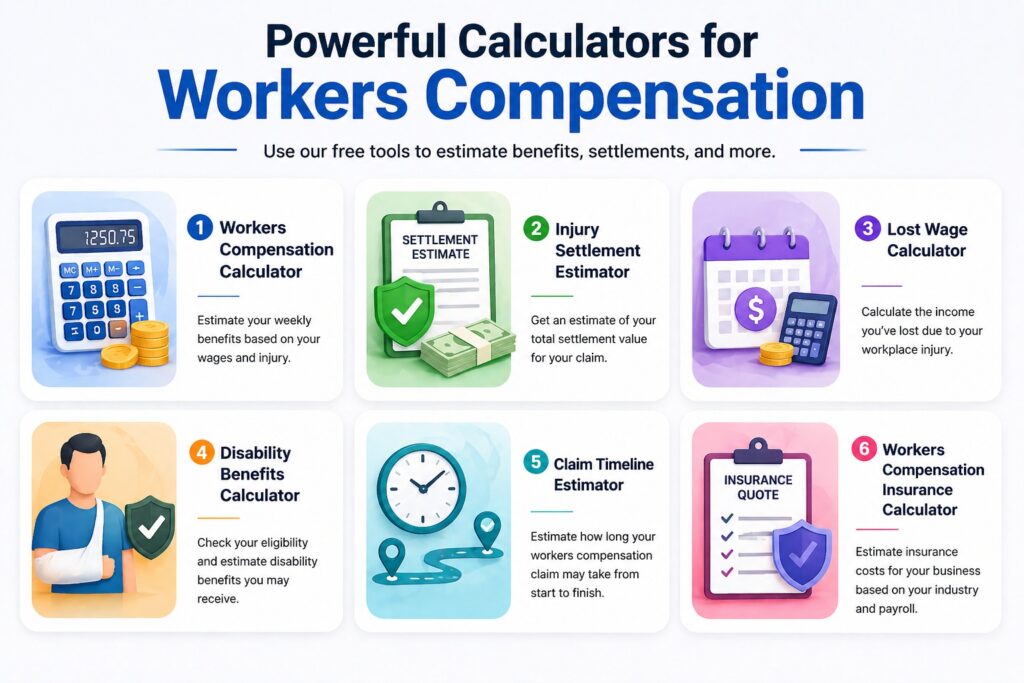
To better understand your claim and estimate your benefits accurately, you can use our free workers compensation tools. These calculators are designed to give you quick insights into your potential payments, settlement value, and claim timeline based on your situation.
- Workers Compensation Calculator – Estimate your weekly benefit amount based on your wages.
- Injury Settlement Estimator – Get an idea of your total claim value including compensation and damages.
- Lost Wage Calculator – Calculate how much income you have lost due to your injury.
- Disability Benefits Calculator – Check your eligibility and estimate disability payments.
- Claim Timeline Estimator – Understand how long your workers compensation claim may take.
- Workers Compensation Insurance Calculator – Estimate insurance costs based on business or job type.

Sponsored: 80+ Free Online Tools : www.toolsmaverick.cloud
FAQs
Is a workers compensation calculator 100 percent accurate? No. It gives you a solid estimate, but the final amount depends on your state, your employer, and how your claim is processed.
Do I need to pay to use a workers compensation calculator? No. Most online calculators, including ours, are completely free.
Does my calculator result affect my actual claim? Not at all. The calculator is just an estimation tool. It has no connection to your official workers compensation claim process.
What if I work multiple jobs? Some states combine your earnings from all jobs to calculate your AWW. Others do not. Check your state rules or use our How to Qualify for Workers Compensation: Eligibility 2026 guide for help.
Are my benefits taxable? In most cases, no. Read our Are Workers Compensation Benefits Taxable blog for a clear answer.
What if my employer disputes my claim? This is where the workers compensation claim process gets complicated. Consider speaking with a lawyer who handles work injury cases.
Conclusion
Knowing what to expect after a work injury makes everything easier to handle. A workers compensation calculator gives you that starting point. It takes your wage, your state’s rules, and your injury type and gives you a number you can actually work with.
But remember, it is an estimate. The real workers compensation claim process involves paperwork, medical evaluations, and sometimes negotiations. The more prepared you are, the better your outcome is likely to be.
Use our workers compensation calculator today to get your free estimate. And if you want to understand the full picture, explore our guides and tools on this site. They are all here to help you get what you are rightfully owed.