
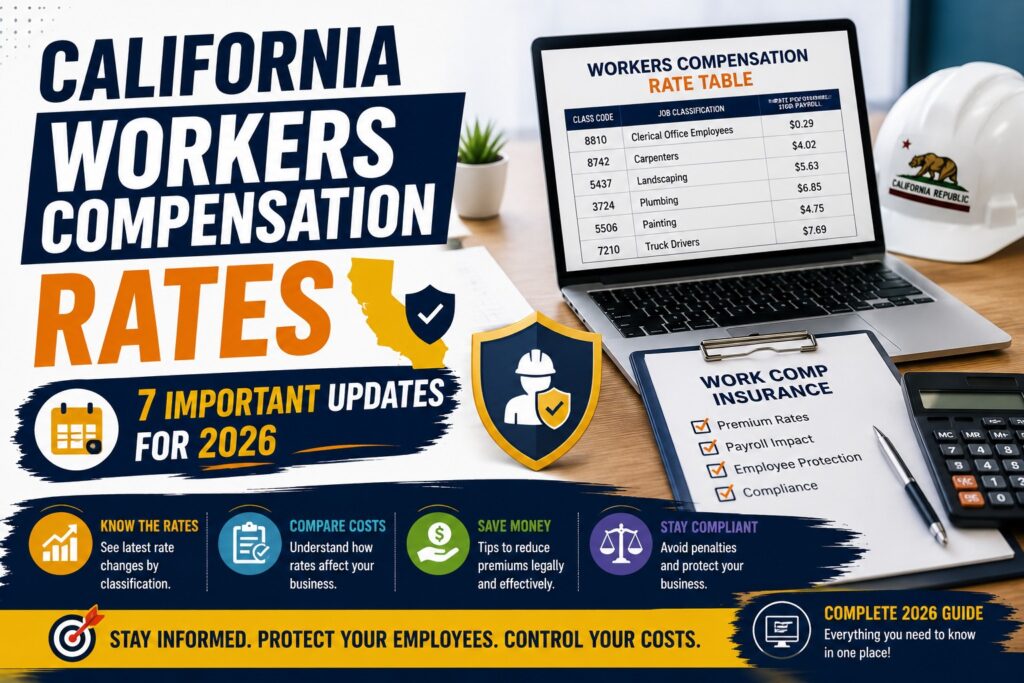
If you got hurt at work in California and someone told you “don’t worry, workers comp will cover it,” you probably felt a little relieved. But then came the real questions. How much will I actually get? How long will it last? What do these numbers even mean? That is where understanding California workers compensation rates becomes really important. Whether you are a worker recovering from an injury or an employer trying to figure out your insurance costs, knowing the actual numbers changes everything.

Let me walk you through everything in plain, simple language. No legal jargon. Just the facts you need.
What Are California Workers Compensation Rates, and Why Do They Matter?
California workers compensation rates refer to two different things, depending on who you are.
If you are an injured worker, rates refer to how much money you get paid every week while you are unable to work because of a job injury. These are called disability benefit rates.
If you are an employer or business owner, rates refer to how much you pay for workers compensation insurance. These are calculated based on your industry, the size of your payroll, and your claims history.
Both of these numbers changed in 2026, and the changes are worth knowing about.
2026 Disability Benefit Rates for Injured Workers
Good news for injured workers. California workers compensation rates for disability benefits went up on January 1, 2026.
Here is what the new numbers look like:
| Benefit Type | Minimum Weekly Rate | Maximum Weekly Rate |
|---|---|---|
| Temporary Total Disability (TTD) | $264.61 | $1,764.11 |
| Permanent Total Disability (PTD) | $264.61 | $1,764.11 |
| Permanent Partial Disability (PD) | $160.00 | $290.00 |
The previous maximum in 2025 was $1,680.29 per week. So injured workers in 2026 can receive up to $83 more every single week. Over the full 104 weeks of allowed temporary disability, that adds up to more than $8,600 in extra benefits.
This increase happened because California ties its disability rates to the State Average Weekly Wage, which rose from $1,704 to $1,789, a jump of nearly 5%. The law requires benefit rates to move with wages, which means workers keep up with the rising cost of living over time.
One very important thing to understand: your benefit rate is locked in based on the date you were injured. If you were hurt on December 31, 2025, you get the old rates. Hurt on January 1, 2026? You get the higher rates. That one day can make a real dollar difference over the life of your claim.
What Does Temporary Disability Actually Pay You?
Temporary disability is what most injured workers receive while they are healing and cannot return to work. California workers compensation rates for temporary disability are calculated as two thirds of your average weekly wage before the injury, but within the minimum and maximum limits.
So if you were earning $1,500 per week before your injury, your temporary disability pay would be about $1,000 per week (two thirds of $1,500). If you earned very little, you still get the minimum of $264.61. If you earned a lot, you are capped at $1,764.11.
To figure out what you might receive, you can use the Workers Compensation Calculator to get a quick estimate based on your wages.
Insurance Rates for Employers: The Big 2025 and 2026 Shift
This is where things get a little more complicated, especially for business owners.
For many years, California workers compensation insurance rates were actually going down. Employers were getting a break. But that changed in 2025 when Insurance Commissioner Ricardo Lara approved an 8.7% increase in the advisory pure premium rate. The new benchmark rate landed at $1.52 per $100 of payroll for policies starting September 1, 2025.
Then in early 2026, the Workers Compensation Insurance Rating Bureau of California voted to recommend another increase of 10.4% for September 1, 2026. That means California workers compensation rates for employers are rising two years in a row after nearly a decade of decreases.
To put that in perspective, most other states in the country are actually cutting their workers comp rates. Texas cut rates by 11.5%. Florida cut rates by 6.9% for the ninth year in a row. New York dropped rates by 13.2%. Meanwhile, California went the opposite direction.
How Your Employer Premium Is Calculated
The formula for California workers compensation rates on the employer side works like this:
Rate x (Payroll divided by 100) x Experience Modifier = Your Premium
Here is a simple example. Say you run an office and your business has $500,000 in annual payroll. If your insurance rate for clerical workers is $0.45 per $100 of payroll, you divide $500,000 by 100 to get $5,000, then multiply by $0.45. Your base premium comes to $2,250 per year.
But a roofing contractor with the same $500,000 payroll could pay a much higher rate, because the risk of injury in roofing is far greater than in an office.
Three main things shape what you pay:
1. Classification Code: Every type of work has a code. Office workers, delivery drivers, nurses, construction workers all have different codes, and each code has its own rate. Getting the wrong code assigned to your employees can cost you thousands of extra dollars per year.
2. Payroll Size: The bigger your payroll, the bigger the base premium. Accurate payroll reporting keeps you from overpaying.
3. Experience Modification (X-Mod): This is like a safety score for your business. If your employees have made fewer claims than average, your X-Mod is below 1.0 and you pay less. If you have had more claims, your X-Mod is above 1.0 and you pay more. A single significant claim from 2023 can still be raising your costs in 2026 and 2027.
Use the Workers Compensation Insurance Calculator to get a rough sense of what your business might owe based on industry and payroll.
Why Are California Rates Higher Than Most States?
California has historically been one of the most expensive states for workers compensation insurance. A few reasons stand out:
Medical costs are rising. Things like surgeries, imaging scans, and therapy sessions cost more in California than the national average. These costs go directly into insurance premiums.
California is highly litigious. More claims end up in legal disputes in California than in most other states. Attorneys get involved more often, which drives up claim costs.
Cumulative trauma claims are increasing. These are claims where workers say their injuries built up slowly over time from repetitive tasks. These claims are harder to manage and more expensive to resolve.
The system has unique costs. California has a process called medical-legal evaluation that does not exist in most states. These evaluations have become significantly more expensive in recent years.
All of this together means that even though injured workers in California receive solid protection, the overall cost to run the system keeps climbing.
Benefits Beyond Temporary Disability
California workers compensation rates cover more than just your weekly check while you heal. The full system includes:
Permanent Disability: If your injury leaves lasting effects, you may receive weekly permanent disability payments. These range from $160 to $290 per week for partial disability. Workers with 100% permanent disability receive the same rate as temporary total disability, paid for life.
Medical Care: All necessary medical treatment related to your injury is covered. Doctor visits, surgery, prescriptions, physical therapy. You should not be paying out of pocket for any of this.
Supplemental Job Displacement: If your injury prevents you from returning to your old job, you may receive a $6,000 voucher to help pay for retraining or education.
Death Benefits: If a worker dies from a job injury, dependents may receive between $250,000 and $320,000 plus burial expenses up to $10,000.
Mileage Reimbursement: You get paid back for driving to medical appointments at $0.70 per mile as of 2025.
To see what your specific injury might be worth overall, the Injury Settlement Estimator can give you a useful starting point.
Calculate Your Income Tax with our free online tool
What Affects Your Settlement Amount?
The California workers compensation rates you receive as a lump sum settlement depend on several things working together:
Your permanent disability rating (a percentage assigned by a doctor) plays the biggest role. The higher the percentage, the more your claim is worth. Your age at the time of injury, your occupation, and how much future medical care you will need all factor in as well.
A quick look at average settlements by injury type shows just how much variation there is:
| Injury Type | Average Settlement Range |
|---|---|
| Head and spine injuries | Up to $91,844 average |
| Back injuries | $30,000 to $75,000 |
| Shoulder and arm | $15,000 to $50,000 |
| Hand and fingers | Lower range, often $10,000 to $30,000 |
For back injuries specifically, which are among the most common workplace injuries in California, you can learn more at the Workers Compensation Settlements for Back Injury guide.
Tips for Workers: Make Sure You Get What You Deserve
Understanding California workers compensation rates is only the first step. Here are a few things that often go wrong and how to protect yourself:
Report your injury right away. Delays can raise questions about whether the injury really happened at work. The sooner you report it, the stronger your claim.
Keep records of everything. Save every doctor’s note, every prescription receipt, every piece of paperwork. These details matter.
Know your injury date. As we talked about earlier, the date of your injury determines which year’s benefit rates apply to your case.
Do not settle too quickly. Insurance companies sometimes make early offers that sound good but fall well short of what your claim is actually worth. Get clarity on your full permanent disability rating before agreeing to anything.
If you are unsure about any of this, read up on Do I Need a Lawyer for Workers Compensation to understand when getting legal help makes sense.
Tips for Employers: How to Keep Your Costs Down
Even though California workers compensation rates are rising, employers are not completely powerless. Here is what actually works:
Audit your class codes regularly. An office worker accidentally classified under a construction code can inflate your premium significantly. This kind of mistake is more common than you might think.
Run accurate payroll reports. Overstated payroll means overpaid premiums. Make sure your numbers are exact.
Manage open claims proactively. Claims that sit unresolved keep your X-Mod elevated for years. Work closely with adjusters to move things forward.
Invest in workplace safety. The best way to lower your long term California workers compensation rates is to reduce injuries before they happen. Safety training, ergonomic improvements, and clear return-to-work policies all help.
Consider a return-to-work program. When injured employees can come back to modified duty rather than sitting at home, claim costs drop and your X-Mod improves over time.
Final Thoughts
California workers compensation rates in 2026 are moving in two different directions at the same time. Injured workers are getting better weekly benefit amounts thanks to the SAWW increase. Employers are facing higher insurance premiums after years of declines. Both sides of this system are changing, and both workers and businesses need to stay informed.
If you have been hurt at work, you have real rights and real money available to help you through recovery. Make sure you know what rates apply to your injury date, track your benefits carefully, and do not accept less than you are owed.
If you are running a business, now is the time to look hard at your classification codes, payroll accuracy, and claims management. You cannot change the advisory rate, but you can absolutely control how your own experience modifier moves over time.
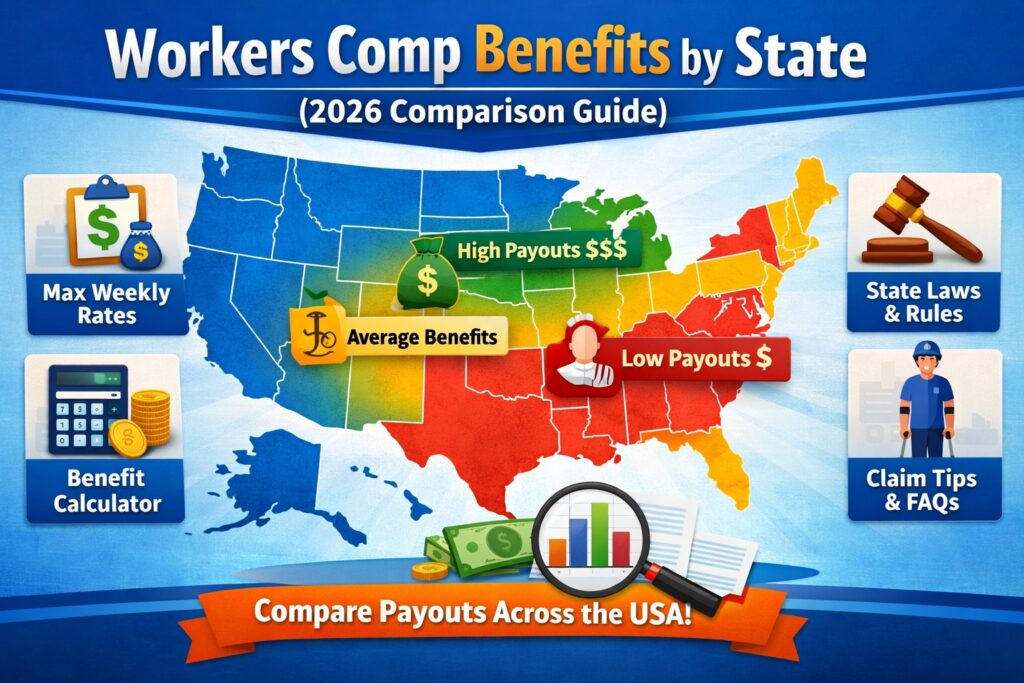
Have questions about what your specific situation might look like? Use the Lost Wage Calculator or the Claim Timeline Estimator to get clearer on your numbers today. And if you want a deeper look at how benefits vary across different states, the Workers Compensation Benefits by State guide is a great next read.
The system is complicated, but the information is out there. The more you know, the better position you are in, whether you are filing a claim or writing the check.