
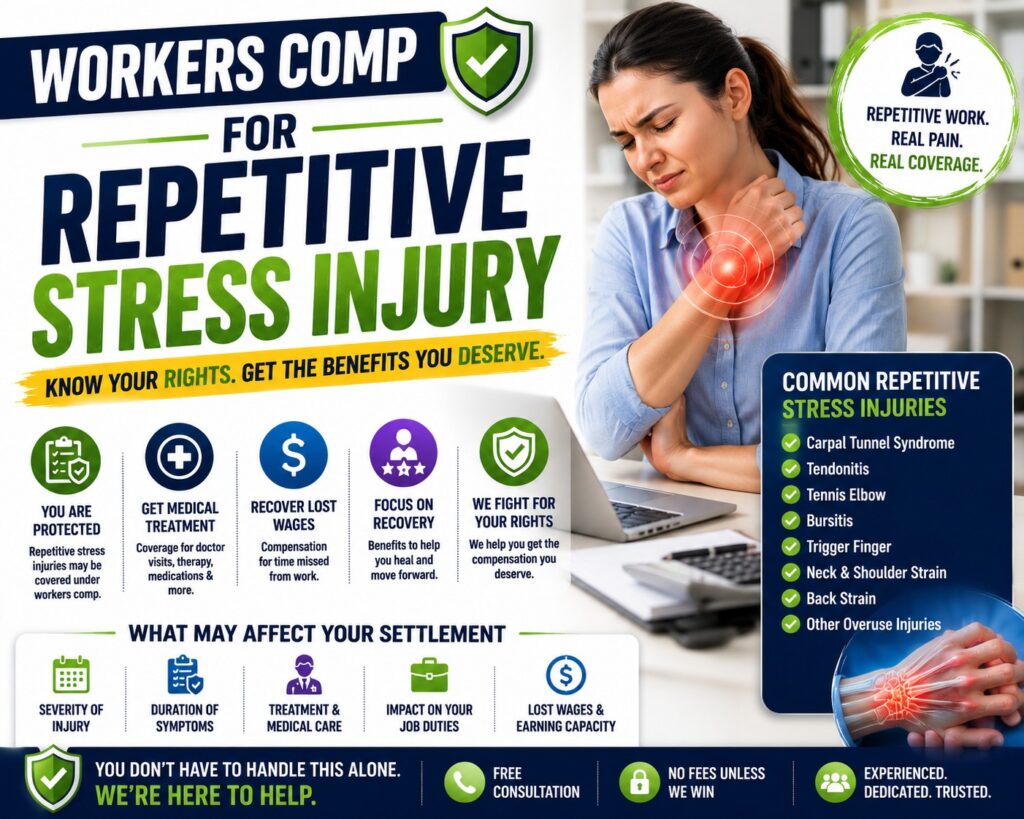
You do the same motion every single day at work. Typing, lifting, scanning, gripping. It does not feel like a big deal at first. But slowly, your wrist starts to ache. Your shoulder feels stiff. Your fingers go numb at night. Before you know it, you are in real pain and wondering if you can even keep working.
Here is the truth most workers do not know: workers comp for repetitive stress injury is a real option. You do not have to fall off a ladder or get hit by something to qualify. Injuries that build up over time are just as valid as sudden accidents in the eyes of the law.
This guide walks you through everything, from what these injuries are, to how to file, to what you can actually get paid.
What Is a Repetitive Stress Injury?
A repetitive stress injury (also called an RSI or cumulative trauma disorder) is damage to your muscles, tendons, or nerves caused by doing the same movement over and over again. It is not one bad moment. It is hundreds or thousands of small moments that slowly wear your body down.
These injuries are extremely common in the American workforce. In fact, the Bureau of Labor Statistics reports that musculoskeletal disorders account for a huge share of all workplace injuries reported each year.
The tricky part is that these injuries do not happen overnight. That is exactly why so many workers wait too long to report them or do not even realize they qualify for workers comp for repetitive stress injury at all.
Can You Get Workers Comp for Repetitive Stress Injuries?
Yes. In all 50 states, workers comp for repetitive stress injury is legally covered under workers compensation laws. Your employer’s insurance is required to cover injuries that happen because of your job, and that includes injuries that develop slowly over time.
That said, these claims are a bit more complex than a typical slip and fall. You need to show that your job duties directly caused or made your injury worse. The good news is that with the right medical documentation and support, many workers successfully receive workers comp for repetitive stress injury every year.

You can also check your state’s specific rules by reading our guide on Workers Compensation Benefits by State to understand what protections apply where you live.
Common Types of Repetitive Stress Injuries
Some of the most frequently seen RSIs in workers comp cases include:
Carpal Tunnel Syndrome: Pressure on the median nerve in the wrist, common in typists, assembly workers, and cashiers.
Tendinitis: Inflammation of tendons from repeated strain, often in the shoulder, elbow, or knee.
Bursitis: Swelling of the fluid sacs that cushion your joints, often caused by repeated pressure or motion.
Trigger Finger: When a finger gets stuck in a bent position due to tendon inflammation, common in workers who grip tools repeatedly.
Rotator Cuff Injuries: Shoulder damage from overhead work like painting, stocking shelves, or construction.
De Quervain’s Tenosynovitis: A painful condition at the base of the thumb, common in workers who do a lot of pinching or gripping.
Tennis Elbow (Lateral Epicondylitis): Pain on the outside of the elbow from repeated arm and wrist movements.
Each of these can qualify you for workers comp for repetitive stress injury if you can show the job caused or significantly contributed to the condition.
Jobs That Frequently Cause Repetitive Stress Injuries
While RSIs can happen in almost any workplace, certain jobs carry much higher risk:
Office workers and data entry clerks spend hours typing and clicking, putting constant strain on wrists and forearms. Assembly line workers perform the same hand and arm motions thousands of times each shift. Grocery store cashiers repeatedly scan and bag items all day long. Nurses and healthcare workers lift patients and perform repetitive tasks that strain their backs and shoulders. Construction workers use vibrating tools and do overhead work that wears joints down fast. Warehouse and delivery workers lift, carry, and bend repeatedly throughout their shifts.
If you work in any of these roles and are dealing with pain that has built up over time, you may have a valid claim for workers comp for repetitive stress injury.
Signs and Symptoms to Watch For
The earlier you catch an RSI, the better your chances of recovery and a strong workers comp claim. Watch for:
Aching, burning, or throbbing pain in a joint or muscle that gets worse during or after work. Tingling or numbness in your hands, fingers, or arms. Swelling or tenderness around a joint. Weakness in your grip or difficulty holding objects. Stiffness, especially in the morning or after sitting still. Pain that used to go away overnight but now stays with you all day.
If you notice any of these signs, do not wait. Seek medical attention and start documenting everything. This documentation will be the backbone of your workers comp for repetitive stress injury claim.
How to Prove Your Injury Is Work-Related
This is where many RSI claims run into trouble. Because these injuries develop gradually, it can be harder to prove they came from work rather than everyday life.
Here is how to build your case:
Get a diagnosis from a doctor, and make sure they document the specific motions or tasks at your job that likely caused the injury. Keep a journal noting when your pain started, how it has gotten worse, and how it connects to your work duties. Gather evidence of your job tasks, like job descriptions, training materials, or coworker statements that confirm what your daily work involves. Ask your doctor to write a letter linking your condition to your employment.

The Workers Compensation Claim Process guide on our site walks through this in more detail and can help you avoid common mistakes when building your case.
How to File a Workers Comp Claim
Filing a claim for workers comp for repetitive stress injury follows the same basic steps as any workers comp claim:
Step 1: Tell your employer about your injury in writing as soon as possible. Keep a copy of everything you send.
Step 2: See a doctor. In many states, your employer or their insurance company gets to choose the first treating doctor, so check your state’s rules.
Step 3: Fill out the official workers comp claim form your employer provides or that your state requires.
Step 4: Your employer is required to report the injury to their insurance carrier.
Step 5: The insurance company will investigate and either approve or deny your claim.
Step 6: If approved, you start receiving benefits. If denied, you have the right to appeal.

One important tool that can help you plan ahead is our Workers Compensation Calculator, which gives you an estimate of what benefits you might be entitled to.
What Benefits Can You Receive?
If your claim is approved, workers comp for repetitive stress injury can cover:
Medical expenses: All necessary treatment, including doctor visits, physical therapy, surgery, and medications related to your RSI.
Lost wages: If your injury prevents you from working, you typically receive a percentage of your average weekly wage, usually around two thirds.
Temporary disability: Short term payments while you recover and cannot work at full capacity.
Permanent disability: If your injury causes lasting damage that affects your ability to work long term, you may qualify for permanent disability benefits.
Vocational rehabilitation: If you cannot return to your previous job, some states provide job training or placement assistance.
You can read more about What Injuries Qualify for Workers Compensation to confirm your specific situation is covered.

Why Repetitive Stress Claims Get Denied
Sadly, workers comp for repetitive stress injury claims are denied more often than accident claims. Here are the most common reasons:
The injury was not reported quickly enough. There is not enough medical evidence linking the injury to work tasks. The insurance company argues the injury came from outside activities, not the job. The worker did not see a doctor soon enough after symptoms started. Pre existing conditions were used as an excuse to deny coverage.
If your claim was denied, do not give up. You have the right to appeal. Check out our resource on what to do if your workers comp claim is denied for your next steps.

How Long Do You Have to Report the Injury?
Every state has a statute of limitations for workers comp claims. For RSIs, the clock often starts from when you knew or should have known your injury was work related, not from when the pain first started.
Most states give you 30 days to notify your employer after discovering the injury. The deadline to file an official claim can range from 1 to 3 years depending on where you live.
Missing these deadlines can cost you your right to benefits entirely, so report your injury as soon as you connect your symptoms to your job duties.
Can You Continue Working While Receiving Benefits?
This depends on how severe your injury is and what your doctor recommends. In many cases, workers receive workers comp for repetitive stress injury benefits while working in a modified or light duty role that does not aggravate their condition.
If your employer offers light duty work that your doctor approves, refusing it could affect your benefits. However, if the offered job makes your injury worse or does not match your restrictions, you may have grounds to decline. Our guide on refusing light duty on workers comp explains your rights in this situation.

Repetitive Stress Injury Settlement Factors
Many workers comp for repetitive stress injury cases end in a settlement rather than ongoing benefits. The amount you receive depends on several factors:
The severity of your injury and how much it limits your ability to work. Your average weekly wage before the injury. Your age and how many working years you have left. Whether you need future medical treatment. The state you work in and its specific benefit formulas. Whether you have any permanent impairment rating from a doctor.
To get a rough idea of what your case might be worth, try our Injury Settlement Estimator tool.
When Should You Hire a Workers Comp Lawyer?
You do not always need a lawyer, but for workers comp for repetitive stress injury claims, having one often makes a real difference. Consider hiring legal help if:
Your claim was denied. The insurance company is pressuring you to return to work before you are ready. Your employer is retaliating against you for filing. You have a permanent impairment and need a fair settlement. You have a pre existing condition that the insurer is using against you.
Most workers comp lawyers work on contingency, meaning they only get paid if you win. You can learn more in our article on Do I Need a Lawyer for Workers Compensation.
Frequently Asked Questions
Can I file for workers comp if my RSI developed over several years? Yes. The key is showing that your job duties were a significant cause of the injury, even if it developed slowly.
What if I also have pain from non work activities? Having outside activities that contribute to the condition does not automatically disqualify you. As long as your job was a major contributing factor, you may still qualify for workers comp for repetitive stress injury.
Will I be fired for filing a claim? It is illegal for your employer to fire or retaliate against you for filing a workers comp claim. If this happens, you have additional legal rights and remedies.
Do I need a specific diagnosis to file? You need a doctor to confirm your injury and ideally connect it to your work. The more specific the diagnosis and medical opinion, the stronger your claim.
Can I choose my own doctor? This depends on your state. Some states allow you to see your own doctor from the start. Others require you to use an employer approved physician first. Check our guide on going to your own doctor for workers comp for state by state details.

Final Thoughts
Repetitive stress injuries are painful, they are real, and they deserve the same respect as any other workplace injury. If your daily job duties have worn down your body over time, you have the right to file for workers comp for repetitive stress injury and get the support you need to heal.
The process can feel overwhelming, especially when insurance companies push back. But the law is on your side. Report your injury early, get proper medical care, document everything, and do not be afraid to seek legal help if things get complicated.
Your health is worth fighting for. Start by using our free Workers Compensation Calculator to estimate what you may be owed, and take that first step toward getting the benefits you deserve.
We Have Collection Of Powerful 70+ free online Calculators access now without Login & Signup
Have questions about your specific situation? Drop a comment below or share this post with a coworker who might need it. Knowledge is the first step to protecting yourself at work.