
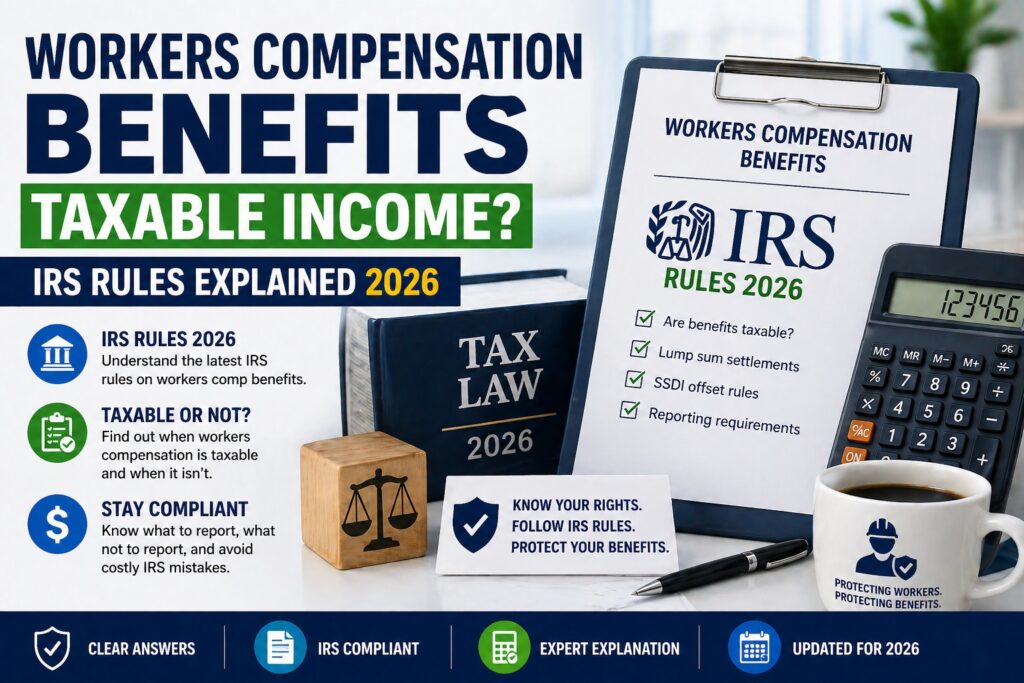
You Got Hurt at Work. Now the IRS Wants to Know About It?
Getting hurt on the job is already stressful enough. Medical bills, missed work, recovery time it’s a lot to handle. Then someone tells you the IRS might want a piece of your workers comp benefits, and suddenly you have a whole new headache on your hands.
Here is the good news: most workers compensation benefits are not taxable. But the word “most” is doing a lot of heavy lifting in that sentence. There are real exceptions, specific situations where you could owe taxes, and rules that confuse even experienced accountants.
This guide breaks down everything you need to know about workers compensation benefits taxable income IRS rules 2026 in plain, simple language. No tax jargon, no confusing legal terms. Just clear answers so you know exactly where you stand.
The Basic Rule: Workers Comp Is Usually Tax Free
Let’s start with the good news and make it crystal clear.
According to the IRS, workers compensation benefits paid under a state or federal workers compensation law are generally not included in your taxable income. That means if you receive weekly wage replacement payments, medical bill coverage, or a lump sum settlement because of a work injury or illness, you typically do not report that money on your tax return.
This rule has been in place for decades and it still holds true. When people ask about workers compensation benefits taxable income IRS rules 2026, the core answer remains the same as prior years: standard workers comp benefits are tax exempt.
But here is where it gets a little complicated.
When Workers Comp CAN Become Taxable
There are a few specific situations where some or all of your workers comp benefits could become subject to federal income tax. Understanding these exceptions is the whole point of staying informed about workers compensation benefits taxable income IRS rules 2026.
The Social Security Offset Rule
This is the most common situation where workers comp creates a tax problem.
If you are receiving both workers compensation and Social Security Disability Insurance (SSDI) or Supplemental Security Income (SSI) at the same time, the Social Security Administration may reduce your SSDI or SSI payments. This reduction is called the “workers comp offset.”
Here is the tricky part. The portion of your workers comp that essentially replaced your SSDI payment is treated as if it were SSDI income by the IRS. And SSDI can be taxable if your total income is above certain thresholds.
So while your workers comp itself is not directly taxable, the offset situation can push you into taxable territory through your Social Security benefits.
To estimate how your wage replacement stacks up, our Lost Wage Calculator can help you see your numbers clearly before tax season hits.
Retirement Benefits Running Alongside Workers Comp
If you retired before your injury and are receiving pension income alongside workers comp, your workers comp may be treated as a pension benefit for tax purposes in some cases. This is less common but worth knowing about.
Interest on a Delayed Settlement
If your workers comp settlement was delayed and the insurance company paid you interest on top of the settlement amount, that interest portion is taxable. The main settlement amount stays tax free, but interest earned on it is treated as regular income.
What Does the IRS Actually Say? (2026 Update)
The IRS guidance for 2026 continues to follow the framework established under IRC Section 104(a)(1). This section specifically excludes from gross income amounts received under workers compensation acts as compensation for personal physical injuries or sickness.
Key points from current IRS rules:
- Workers comp received for physical injuries or illness is excluded from income
- Benefits must be paid under a workers compensation statute
- Benefits paid for emotional distress alone (without a physical component) may not qualify for the exclusion
- Retirement plan payments that are workers comp substitutes can be taxable
If you want to go straight to the source, the IRS covers this in Publication 525, which is updated each year and is the go to reference for taxable and nontaxable income.
Understanding workers compensation benefits taxable income IRS rules 2026 means reading this publication carefully or working with a tax professional who does.
State Taxes on Workers Comp: A Different Story
Federal tax rules are one thing. State taxes are another.
Most states follow the federal lead and exempt workers comp from state income tax as well. However, a small number of states have their own rules, and these can vary. Some states may tax certain types of settlement payments differently than the federal government does.
Our Workers Compensation Benefits by State (Updated Guide 2026) breaks down exactly how your state handles these payments so you are not caught off guard at state tax time.
Lump Sum Settlements and Taxes
This question comes up constantly: “I received a lump sum workers comp settlement. Is it taxable?”
In most cases, no. A lump sum that settles your workers compensation claim is treated the same as regular weekly workers comp payments under IRS rules. It is generally not taxable income.
However, if your settlement agreement covers multiple types of damages such as combining workers comp with a personal injury lawsuit, a disability payment, or back wages, the tax treatment of each piece may differ. Back wages included in a settlement, for example, are typically taxable.
This is why how a settlement is structured and worded matters a great deal. An attorney or tax professional can help make sure your settlement agreement is written in a way that protects the most money possible.
To get a rough sense of what a fair settlement might look like for your situation, our Injury Settlement Estimator can walk you through the numbers.
A Quick Reference Table
Here is a simple breakdown to keep things clear:
| Type of Benefit | Taxable? |
|---|---|
| Weekly wage replacement (workers comp) | Generally No |
| Medical bill reimbursement | No |
| Lump sum workers comp settlement | Generally No |
| Workers comp offset against SSDI | Possibly Yes |
| Interest on delayed settlement | Yes |
| Back wages included in settlement | Yes |
| Emotional distress only (no physical injury) | Possibly Yes |
| Retirement/pension treated as workers comp substitute | Possibly Yes |
This table gives you a quick snapshot, but your individual situation may differ. Always confirm with a tax professional if you are unsure.
Do You Need to Report Workers Comp on Your Tax Return?
If your workers comp is fully tax exempt, you generally do not list it as income on your federal return. You do not need to report it on line one of your 1040 or anywhere else as income.
But you should still keep records of what you received. If you are in the offset situation described above with SSDI, you will need to account for that carefully.
Also, if you went back to work partway through the year and received a mix of regular wages and workers comp benefits, your wages are taxable and your workers comp is not. Keeping these amounts separate in your records makes tax filing much easier.
For a full walkthrough of how benefits are calculated and what you might qualify for, check out our guide on How to Work Out Workers Compensation (Step-by-Step Guide 2026) which covers the math in plain terms.
Common Mistakes People Make With Workers Comp and Taxes
Knowing workers compensation benefits taxable income IRS rules 2026 is one thing. Avoiding common errors is another.
Mistake 1: Reporting all workers comp as income. Some people see the payments coming in and assume they must be taxable. They are not, in most cases, and over reporting can cost you money through incorrect tax calculations.
Mistake 2: Ignoring the SSDI offset. People receiving both workers comp and SSDI sometimes do not realize the offset creates a tax issue with their Social Security benefits. This leads to surprise tax bills.
Mistake 3: Not keeping records. Even if your workers comp is not taxable, you should keep all documentation in case the IRS asks questions during an audit.
Mistake 4: Assuming state rules match federal rules. They usually do, but not always. Always check your specific state’s rules.
Tips for Staying Protected
Here are practical steps to protect yourself:
- Keep copies of all workers comp payments you receive throughout the year
- Ask your attorney to clarify what your settlement covers if you receive a lump sum
- Tell your tax preparer about any workers comp you received so they can handle it correctly
- If you receive SSDI, ask your Social Security caseworker about how your workers comp affects your benefits
- Check IRS Publication 525 each year for any updates to the rules
Workers compensation benefits taxable income IRS rules 2026 have not changed dramatically from previous years, but it is always smart to verify before you file.
Final Thoughts: Keep More of What You Earned
Work injuries are hard enough without worrying that the government will take a share of your recovery benefits. The good news is that the IRS rules are largely on your side when it comes to standard workers comp payments. Most people will not owe a single dollar in federal tax on their benefits.
But the exceptions exist, they catch people off guard, and knowing about them in advance makes a real difference. Whether it is the SSDI offset, interest on a delayed settlement, or a mixed settlement that includes wages, these are the areas that deserve your attention.
Now that you understand workers compensation benefits taxable income IRS rules 2026, you are in a much better position to protect your money and avoid costly mistakes.
Did this guide help you? Share it with someone who is dealing with a workers comp situation and could use clear, honest answers. And if you have questions about your own case, drop them in the comments below. We read every one.