

Getting Hurt at Work Is Scary. Here Is What Protects You.

Nobody goes to work expecting to get injured. But accidents happen every single day, on construction sites, in warehouses, at offices, and everywhere in between. If you are a worker in the Pacific Northwest, understanding workers compensation Washington state is one of the most important things you can do for yourself and your family.
Washington state has one of the most worker-friendly compensation systems in the entire country. But it works differently from most other states, and if you do not know how it operates, you could miss out on benefits you are fully entitled to. This guide breaks it all down in plain, simple language so you know exactly where you stand.
How Workers Compensation Washington State Actually Works
Most states allow private insurance companies to handle workers comp. Washington state does things differently. Workers compensation Washington state is run through a state agency called the Department of Labor and Industries, commonly known as L&I.

This means your employer does not go out and shop for a private insurer. Instead, they pay premiums directly to the state, and L&I manages your claim when you get hurt. There are some large employers called self-insurers who handle their own claims, but the vast majority of workers in Washington are covered through L&I.
This state-run system has some real advantages. It tends to be more consistent, more regulated, and harder for employers to manipulate. When you file a workers compensation Washington state claim, you are dealing with a government agency that has clear rules, not a private company trying to protect its profits.
Who Is Covered Under Washington State Workers Comp?
Almost every worker in Washington is covered. That includes full-time employees, part-time workers, and even some contract workers depending on the situation. If your employer controls how and when you work, there is a good chance you qualify.
There are a few exceptions. Some agricultural workers, domestic workers, and sole proprietors may fall outside the standard coverage rules. Federal employees are covered under a separate federal program, not through L&I.

If you are unsure whether you qualify, you can read more about how to qualify for workers compensation based on your specific situation. The rules can vary depending on your job type and employment classification.
What Benefits Can You Expect?
Workers compensation Washington state covers several different types of benefits. Here is a simple breakdown of what you may be entitled to after a work injury.
Medical Benefits
All reasonable and necessary medical treatment related to your injury is covered. This includes doctor visits, hospital stays, surgeries, physical therapy, prescription medications, and medical equipment. You do not pay out of pocket as long as the treatment is approved and related to your work injury.
Wage Replacement (Time Loss Payments)
If your injury keeps you from working, you can receive time loss compensation. Workers compensation Washington state pays around 60 to 75 percent of your gross wages, depending on how many dependents you have. These payments continue while you are medically unable to work.
Permanent Partial Disability
If your injury causes a permanent impairment, even after you have recovered as much as possible, you may receive a lump sum payment. This is based on how much function you have permanently lost.
Vocational Rehabilitation
If you cannot go back to your old job, L&I may help you retrain for a new career. This is one of the more generous parts of workers compensation Washington state compared to other states.
Pension Benefits
For the most serious injuries that result in total permanent disability, workers may qualify for a lifetime pension. This is rare but it exists for the most severe cases.
To get a rough idea of what your claim might be worth financially, try using this Workers Compensation Calculator to estimate your benefits before you even speak to anyone.
How to File a Workers Comp Claim in Washington
Filing a claim under workers compensation Washington state is not as complicated as people often fear. Here is what the process looks like step by step.
Step 1: Report Your Injury
Tell your employer right away. Washington law requires you to report your injury as soon as possible. Waiting too long can create problems for your claim.
Step 2: See a Doctor
Get medical attention immediately. The doctor you see will file a Report of Industrial Injury with L&I, which officially opens your claim. Make sure you tell the doctor this is a work injury.
Step 3: L&I Reviews Your Claim
L&I will look at the information submitted and decide whether to accept or deny your claim. They may ask for additional information during this process.
Step 4: Receive Benefits
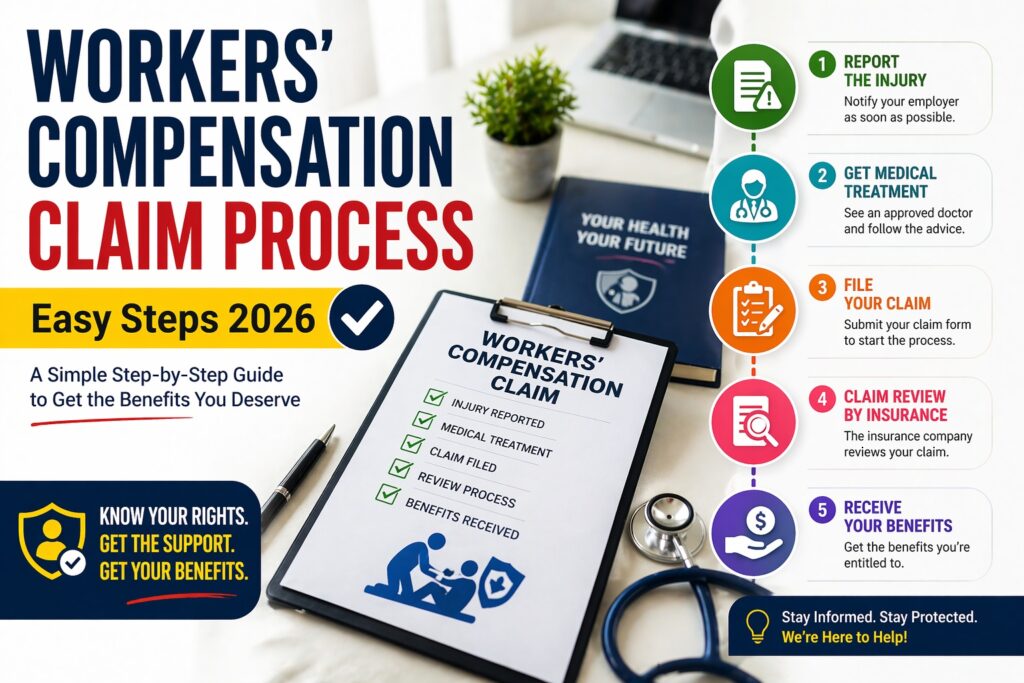
Once your claim is accepted, your medical bills start getting paid and your time loss payments begin if you are unable to work. For a more detailed walkthrough, check out this guide on the workers compensation claim process.
Important Deadlines You Cannot Ignore
One of the most common mistakes workers make is waiting too long to act. Workers compensation Washington state has strict time limits.
You generally have one year from the date of your injury, or from when you knew your condition was work-related, to file a claim. For occupational diseases, the clock may start ticking differently. Missing these deadlines can mean losing your right to benefits entirely.
Report your injury to your employer immediately. Do not wait to see if it gets better on its own.
What If Your Claim Gets Denied?
It happens more often than people think. L&I may deny your claim for various reasons, such as saying the injury was not work-related or that you did not report it in time. A denial is not the end of the road.
You have the right to appeal a denied claim. The appeals process in workers compensation Washington state involves requesting a hearing before the Board of Industrial Insurance Appeals. You can present evidence, bring witnesses, and argue your case.

If you find yourself in this situation, you may want to read about what to do if your workers comp claim is denied so you understand your options and next steps.
A Quick Comparison: Washington vs. Other States
| Feature | Washington State | Most Other States |
|---|---|---|
| Who manages claims | State agency (L&I) | Private insurers |
| Medical coverage | Full, no copays | Varies by insurer |
| Wage replacement | 60 to 75 percent of gross wages | Typically 66 percent of net wages |
| Vocational rehab | Robust program available | Varies widely |
| Appeals process | Board of Industrial Insurance Appeals | Varies by state |
Workers compensation Washington state is generally considered more protective of workers compared to many other states, largely because private insurers are not in the middle trying to cut costs.
Common Mistakes That Hurt Your Claim
Many workers unintentionally weaken their own workers compensation Washington state claim. Here are the biggest mistakes to avoid.
Waiting too long to report the injury is the number one problem. The longer you wait, the easier it is for L&I to question whether the injury really happened at work.
Not being honest with your doctor is another serious issue. Describe every symptom clearly and accurately. Do not downplay your pain to appear tough. Your medical records are the foundation of your claim.
Going back to work before you are ready can also hurt you. If you return too soon and re-injure yourself, it complicates the claim significantly.
Finally, not keeping records of everything is a mistake. Save all paperwork, doctor notes, receipts, and communications related to your injury.
Can You Lose Your Job While on Workers Comp?

This is one of the most common fears workers have. The short answer is that Washington state has strong anti-retaliation laws. Your employer cannot legally fire you simply because you filed a workers comp claim. However, this does not mean job loss never happens. Understanding your rights is critical. You can learn more about whether you can be fired while on workers compensation and what protections apply to you.
Do You Need a Lawyer?
Not always, but sometimes yes. Simple claims that get accepted quickly and involve clear medical treatment usually do not require legal help. However, if your claim is denied, if there is a dispute about your disability rating, or if your employer is making things difficult, having legal representation can make a significant difference in the outcome.
Workers compensation Washington state law allows attorneys to work on a contingency basis in many situations, meaning you do not pay unless you win.
Final Thoughts: Know Your Rights Before You Need Them
Nobody plans to get injured at work. But knowing how workers compensation Washington state works before an accident happens puts you in a much stronger position if something does go wrong. You know what to report, when to report it, what benefits you are entitled to, and what to do if things go sideways.
Washington has built a system that genuinely tries to take care of injured workers. Take advantage of it. Use the tools available to you, ask questions, and do not be afraid to push back if your claim is handled unfairly.
If you want to estimate what your lost wages might look like during recovery, the Lost Wage Calculator is a great starting point to understand your financial situation.
Calculate Your Saving With Our Calculator
Have questions about your specific situation? Drop them in the comments below, share this post with a coworker who might need it, or explore more guides on the site to learn about your full rights as an injured worker. You worked hard to earn these protections. Make sure you use them.